Is Surface Topography for Scoliosis Evidence-Based? What Formetric Scans Can (and Can’t) Tell You | Chiropractor Cape Town
Introduction
If you’ve been told you or your child has scoliosis, you may have come across clinics offering 3D posture scans, Formetric imaging or surface topography.
These technologies use cameras and optical scanners to create a three-dimensional model of the back without exposing the patient to radiation.
The question is:
Are these scans evidence-based?
The answer is yes—but only when used appropriately.
Unlike many digital posture scanning systems marketed for general back pain, validated surface topography systems such as Formetric have scientific evidence supporting their use for monitoring known adolescent idiopathic scoliosis.
However, they also have important limitations.
Surface topography cannot diagnose scoliosis on its own, does not replace X-rays, and does not demonstrate that chiropractic treatment can correct a structural scoliosis.
If you’re looking for an evidence-based Chiropractor Cape Town, understanding these differences is essential.
What Is Surface Topography?
Surface topography is a non-invasive imaging technique that analyses the shape of the back using cameras and projected light.
Instead of taking an X-ray, the scanner creates a three-dimensional model of the body’s surface.
Some systems estimate:
- spinal curvature
- trunk rotation
- pelvic position
- shoulder asymmetry
- overall body balance
Because no radiation is used, scans can be repeated frequently.
What Is Formetric?
Formetric is one of the best-known surface topography systems used internationally.
It uses optical imaging rather than radiation to estimate changes in spinal shape over time.
It is primarily used for:
- monitoring adolescents with known scoliosis
- tracking progression during growth
- reducing unnecessary repeat X-rays
- assisting with clinical follow-up
It is not designed to replace radiographic assessment.
Can Surface Topography Diagnose Scoliosis?
No.
This is one of the biggest misconceptions.
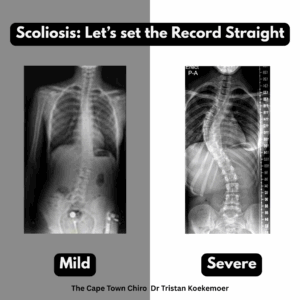
The diagnosis of scoliosis still requires appropriate clinical assessment and, when indicated, standing spinal radiographs.
The Cobb angle, measured on an X-ray, remains the internationally accepted gold standard for diagnosing and classifying structural scoliosis.
Surface topography estimates body shape—it does not directly measure the bones of the spine.
Why Is Surface Topography Useful?
Repeated X-rays expose patients to small amounts of ionising radiation.
Although individual doses are low, adolescents with progressive scoliosis may require multiple images during periods of rapid growth.
Surface topography can reduce the number of X-rays needed by helping clinicians monitor changes between radiographic assessments.
This is where the strongest scientific evidence exists.
It is a monitoring tool, not a replacement for imaging.
Can Surface Topography Measure Progress?
Yes—with limitations.
Research has shown that validated systems such as Formetric demonstrate good reliability for measuring changes in trunk shape and body symmetry over time.
However, body surface measurements are not identical to changes in the Cobb angle.
For this reason, significant treatment decisions still require radiographic confirmation.
Can Chiropractic Correct Structural Scoliosis?
This is where it is important to separate two different questions.
Can chiropractic help someone who has scoliosis?
Yes.
People with scoliosis may experience:
- back pain
- muscle stiffness
- reduced mobility
- exercise limitations
Evidence-based chiropractic care, exercise therapy and manual therapy may help manage these symptoms in some patients.
Can chiropractic reverse or permanently straighten an adult structural scoliosis?
Current scientific evidence says no.
Structural scoliosis cannot be corrected through spinal manipulation alone.
In adults, meaningful correction generally requires surgery, and even then surgery is reserved for carefully selected cases.
Most adults with scoliosis never require surgery.
Beware of “Before and After” Pictures
Some clinics use repeat posture scans to claim dramatic improvements in scoliosis.
This can be misleading.
A person’s surface appearance changes with:
- breathing
- muscle tension
- standing position
- weight distribution
- fatigue
Small differences between scans do not necessarily represent structural changes in the spine.
Only repeat radiographs measuring the Cobb angle can confirm whether the spinal curve itself has changed.
What Does an Evidence-Based Chiropractor Do?
An evidence-based Chiropractor Cape Town understands both the strengths and limitations of surface topography.
Assessment should include:
✓ A detailed history
✓ Physical examination
✓ Neurological assessment
✓ Appropriate referral for imaging when indicated
✓ Monitoring using validated tools where appropriate
Treatment focuses on:
- reducing pain
- improving movement
- increasing strength
- maintaining function
- supporting long-term physical activity
Not on promising to “straighten” a structural scoliosis.
Conclusion
Surface topography is one of the few optical scanning technologies in musculoskeletal healthcare that has legitimate scientific value.
Its greatest strength is helping monitor known adolescent idiopathic scoliosis while reducing unnecessary exposure to repeated X-rays.
However, it is not a diagnostic test, it cannot replace the Cobb angle, and it does not prove that any treatment—including chiropractic—can reverse structural scoliosis.
Good healthcare means using the right tool for the right job.
Surface topography is one of those tools—but only when its capabilities are understood honestly.
Frequently Asked Questions
Can surface topography diagnose scoliosis?
No. A diagnosis of scoliosis requires a clinical assessment and, when indicated, standing spinal X-rays. The Cobb angle remains the gold standard.
Is Formetric scanning accurate?
Validated Formetric systems have demonstrated good reliability for monitoring changes in trunk shape and body symmetry. They are useful for follow-up but do not replace radiographs.
Can chiropractic fix scoliosis?
Chiropractic may help manage pain, stiffness and movement limitations associated with scoliosis, but there is no strong evidence that spinal manipulation can reverse a structural scoliosis.
Does every person with scoliosis need surgery?
No. Most people with scoliosis are managed without surgery. Treatment depends on factors such as age, curve size, progression and symptoms.
Looking for an evidence-based Chiropractor Cape Town?
If you or your child has scoliosis, it’s important to receive honest advice based on current evidence.
At The Cape Town Chiro, we focus on:
✓ Thorough assessment
✓ Evidence-based chiropractic care
✓ Appropriate referrals when needed
✓ Exercise and rehabilitation
✓ Helping you understand what treatment can—and cannot—achieve
Our goal isn’t to promise miracle corrections. It’s to help you make informed decisions about your spine and your health.
Sources
Surface Topography
SOSORT Guidelines (2016 & 2023 updates)
The international scoliosis guidelines acknowledge that validated surface topography systems can be useful for monitoring scoliosis progression and reducing unnecessary radiographs.
Goldberg CJ et al.
Validation studies comparing Formetric with radiographic Cobb angle.
Conclusion:
Good correlation for monitoring.
Not a replacement for X-rays.
Hackenberg et al.
Repeated validation of raster stereography (Formetric).
Shows:
- good reproducibility
- radiation-free monitoring
- appropriate adjunct
Scoliosis Research Society (SRS)
Diagnosis of scoliosis still requires radiographic Cobb angle.
Surface topography is considered an adjunct.
SOSORT Conservative Management Guidelines
Exercise
Bracing
Monitoring
Radiographs
Surface topography
No recommendation that chiropractic manipulation corrects structural scoliosis.
Related Articles
Are Digital Posture Scans Evidence-Based? What the Science Actually Says | Chiropractor Cape Town
Does Posture Cause Pain? The Truth About Posture | Chiropractor Cape Town Explains
Is the Gonstead Technique Evidence-Based? The Science Behind Gonstead Chiropractic
Do I Need X-rays Before Seeing a Chiropractor?
Subluxations Are Not Real: Why Modern Chiropractic is Evidence-Based in Sea Point